If you’ve started seeing the term Generative Engine Optimization show up in marketing conversations, you’re probably wondering whether it’s actually different from SEO, or just a new name for the same work. The honest answer is that GEO and SEO are close cousins, not opposites. They share most of their foundation. But the places where they diverge matter, and they matter more every quarter as AI assistants take over a bigger share of how people search.
Here’s a clear breakdown of what each one is, where they overlap, where they don’t, and how to decide where to put your effort first.
The short version
SEO (Search Engine Optimization) is about ranking inside a list of search results so a human clicks your link.
GEO (Generative Engine Optimization) is about being cited inside an AI-generated answer so a human reads about you without ever seeing a list of links.
Same general goal: be the source customers find first. Different mechanics for getting there.
Where they come from the same place
Before we talk about differences, it’s worth saying clearly that good SEO and good GEO share most of their DNA. Both reward:
- Quality content that genuinely answers a real question
- Technical health: fast pages, clean code, crawlable architecture
- Authority signals like author credentials, organizational reputation, and earned mentions on other trusted sites
- Freshness, because both Google and AI retrievers prefer recently updated material
- Clear structure with headings, lists, and a logical hierarchy
If your SEO is weak, your GEO will be weak too. There is no version of GEO that bypasses good SEO fundamentals. The fastest way to start ranking inside AI answers is, almost always, to fix the basics that should already be in place for traditional search.
Where they actually differ
Once the foundation is solid, GEO and SEO start rewarding different things at the top of the stack.
The goal is different
SEO competes for a click. The win condition is landing in the top three blue links so a user clicks through to your site.
GEO competes for a citation. The win condition is being one of the sources an AI uses to compose its answer, sometimes with a link, sometimes with a brand mention, sometimes with both.
That difference cascades into nearly every other contrast.
The format is different
SEO rewards content that targets a keyword and supports it with depth. Long-form pillar pages with comprehensive coverage have dominated for the last decade.
GEO rewards content that answers a question completely in the first 100 words and then expands. The model is trying to extract a quotable answer, not read your whole article. If your direct answer is buried under three paragraphs of warm-up, the model often gives up before it finds it.
Practical implication: lead with the answer. Always.
The structure is different
Both reward clean structure, but GEO is more demanding about it. AI engines lift bullets, definitions, tables, and FAQ blocks into their answers far more readily than they lift prose paragraphs.
If you write a numbered list of “five ways to choose a digital marketing agency,” that list is more likely to appear verbatim in an AI answer than the same five ideas written out as paragraphs. SEO is largely indifferent to that distinction. GEO is not.
The authority signals look different
SEO authority is measured in backlinks, domain rating, and ranking history. AI engines use those signals too, but they also weigh things SEO largely ignores:
- Author bylines and credentials that establish individual expertise
- Mentions across the open web, even when those mentions don’t come with a link
- Consensus: whether multiple credible sources agree on the same fact
- Publication context, including whether your site looks like a real organization with a history
A site that ranks well in Google because of strong link-building can still get ignored by AI engines if it lacks visible authorship and organizational depth. Conversely, a small site with strong author signals and well-cited original research can punch above its weight in AI answers.
The measurement is different
SEO success is tracked in rankings, organic sessions, and click-through rates, metrics that have been standard for two decades.
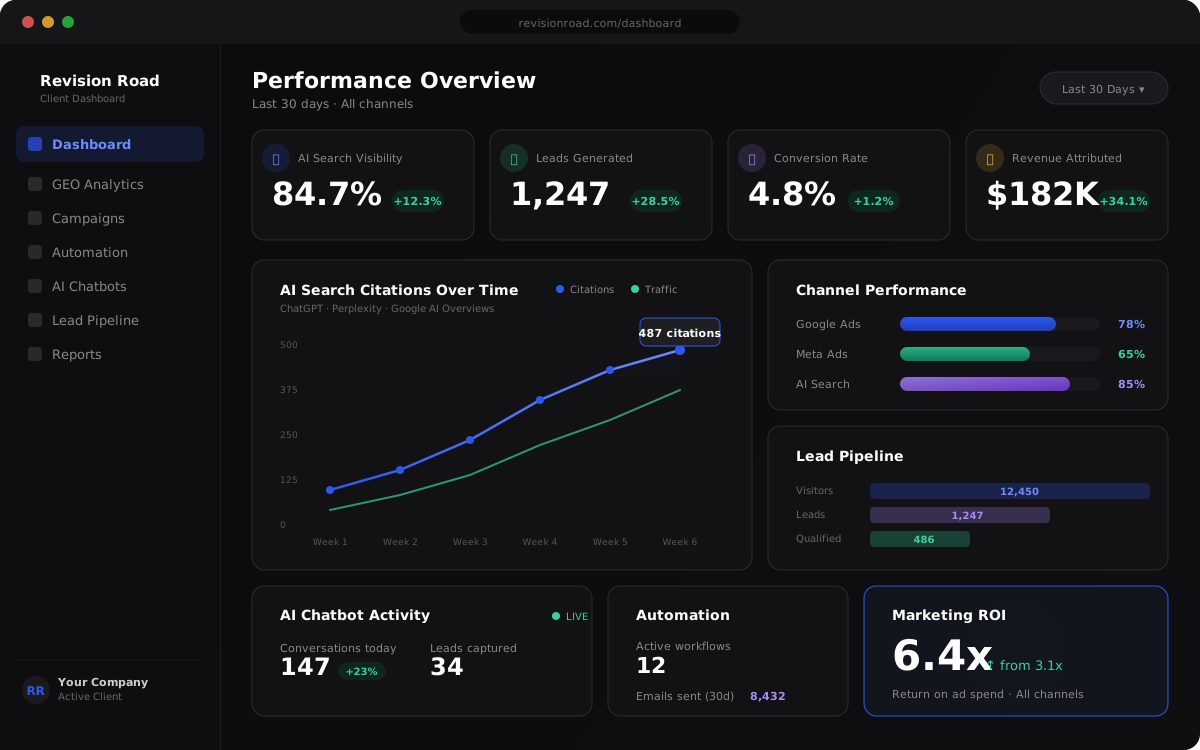
GEO success is tracked in citations, brand mentions inside AI answers, branded search lift, and assisted conversions from AI referral traffic. Some of those signals don’t show up in your analytics at all unless you go looking for them.
A business can have a wildly successful GEO program and see only modest changes in its traffic dashboard. The wins show up as rising branded search volume, higher-quality leads who already know your name, and citations in tools like ChatGPT, Perplexity, and Google AI Overviews. If you only watch sessions, you’ll undercount the real impact.
A side-by-side comparison
For a quick reference, here’s how the two stack up:
- Goal: SEO wins a click. GEO wins a citation.
- Surface: SEO appears on a search results page. GEO appears inside an AI-generated answer.
- Format reward: SEO rewards depth. GEO rewards directness and depth.
- Structure reward: SEO is helped by structure. GEO is dependent on it.
- Authority signal: SEO leans on backlinks. GEO leans on backlinks plus author and organizational signals.
- Freshness pressure: SEO benefits from fresh content. GEO penalizes stale content harder and faster.
- Primary metric: SEO tracks rankings and sessions. GEO tracks citations, mentions, and branded search lift.
- Time horizon: SEO results compound over months. GEO results can move in weeks once foundations are in place.
So do you need both?
For almost every business reading this: yes, and you need them in the right order.
Here’s the simplest way to think about it. SEO and GEO share roughly 70% of the same work. That shared 70% (quality content, technical health, structure, authority, freshness) is non-negotiable. You can’t skip it and hope to rank in AI answers, because AI engines pull from the same web that Google indexes.
The remaining 30% is where they diverge, and that’s where the question of priority becomes interesting.
When to prioritize SEO first
If your business is new, your site is small, or your fundamentals are weak, start with SEO. There is no shortcut around having a fast, well-structured, crawlable site with content that answers real questions. Until that foundation is in place, GEO-specific tactics won’t have anything to build on.
You should also lean SEO-first if your customers still primarily find you through traditional search. Some industries (local services, ecommerce in established categories, regulated B2B) are still dominated by Google’s traditional results, and the AI shift is happening more slowly there.
When to prioritize GEO first
If your fundamentals are already strong and you’re seeing your competitors get cited by AI tools while you don’t, GEO is the higher-leverage investment. The same is true if your audience tends to be early-adopter, knowledge workers, technologists, marketers, founders, anyone who has already shifted a meaningful share of their research to ChatGPT or Perplexity.
GEO is also worth prioritizing in categories where the AI shift is happening fast. Software, marketing services, professional consulting, and high-consideration B2B purchases are all categories where AI tools are now a routine part of the buying journey. If that describes your space, you can’t afford to wait.
When to run them together
The honest answer for most businesses is that the two should be running in parallel from day one. The shared 70% work serves both. The GEO-specific 30% is mostly a refinement of how you write, structure, and update the same content you would have published anyway.
That’s not extra work. It’s slightly better work. And the businesses that get it right today will be miles ahead of the ones that wait.
What this looks like in practice
Across every industry we work with, from professional services to nonprofits to ecommerce, the businesses winning at both SEO and GEO are doing the same handful of things:
- Publishing fewer, deeper pages instead of hundreds of thin ones
- Leading every section with a direct answer the model can quote
- Updating their most important content on a quarterly cadence
- Adding clear authorship, schema markup, and original data
- Making sure AI crawlers can actually access their site
- Tracking brand mentions inside AI tools, not just sessions in their analytics
None of that is exotic. It’s basic content discipline applied with awareness of how AI engines now read the web.
If you want the full playbook, our complete guide to Generative Engine Optimization walks through every step, from technical foundations to measurement. And if you’d rather have a partner do the heavy lifting, our GEO and SEO service is built around exactly this kind of integrated approach.
The bottom line
GEO and SEO aren’t competing disciplines. They’re two layers of the same job: helping the right customers find your business when they go looking. SEO won the last era. GEO is winning the next one. Almost every business should be doing both, and the ones that start now will have an outsized advantage over the ones that wait until AI search is too obvious to ignore.
If you want to know where your business stands across both today, request a free AI Visibility Audit. We’ll show you what AI tools say about you, where the gaps are, and what to fix first.